Do pimple patches work on blackheads?
Pimple patches draw fluid out of pimples, and a blackhead is a plug of oil and dead skin cells. What patches can do for blackheads, and what clears them.
By Nick, Founder of Skinli. Not a doctor. General education only.
Part of the Spot care, which puts every step in order.
Pimple patches are made for pimples, and blackheads are a different type of spot. A patch draws fluid out of a pimple and keeps fingers off it. A blackhead is a plug of oil and dead skin cells in an open pore. No study that Skinli could find tests pimple patches on blackheads. This guide explains what each one is, where patches help, where medicated patches fit, and what the American Academy of Dermatology (AAD) recommends for blackheads. Skinli gives general education and is not a doctor. For the question of squeezing any spot, see should you pop a pimple.
What a blackhead is
The AAD says a blackhead "develops when excess oil and dead skin cells build up inside a pore. As the buildup accumulates, it widens the opening of the pore and you see a blackhead." Its medical name is "Open comedo, which means 'open pore.'"
The dark color is a chemical reaction. The AAD explains: "When the buildup inside the pore reacts with oxygen in the air, the black color appears. This reaction is similar to what happens when a cut-up apple turns brown." It adds that the black dots "aren't dirt, so resist scrubbing. It will only worsen your acne."
So a blackhead is a plug of built-up oil and dead skin cells. The guide how to get rid of blackheads covers the full picture.
What a pimple patch does
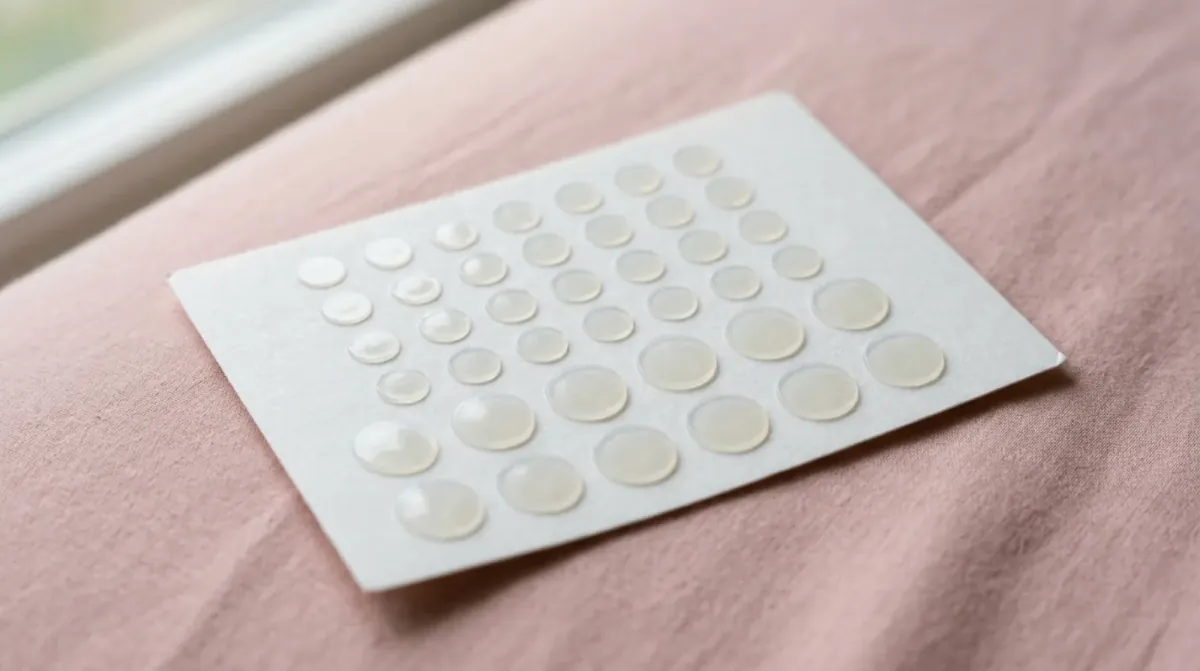
Most pimple patches are made of hydrocolloid, a soft material also used in wound dressings. A 2025 review in the Journal of Clinical Medicine says hydrocolloid dressings work "by forming a gel-like protective layer upon the dispersion of water, absorbing exudate, and creating a moist environment." Exudate is fluid that comes out of a wound or an open spot.
A dermatologist quoted by the AAD in 2025 said pimple patches "help draw out fluid from pimples and stop you from picking, but they won't work on deep acne." The AAD's steps for a sore pimple add that "a hydrocolloid acne patch can be applied to protect your skin and improve healing."
The one published trial of a hydrocolloid acne dressing, from 2006, studied 20 people with mild to moderate acne. It measured overall acne severity, inflammation, redness, oiliness and dark marks. It did not count blackheads.
Why patches and blackheads do not match
Put the two descriptions side by side:
| Pimple patch | Blackhead | |
|---|---|---|
| What it is | A cover that absorbs fluid and forms a gel | A plug of oil and dead skin cells in an open pore |
| What is involved | Fluid from a pimple, per the AAD's quoted dermatologist | A buildup of oil and dead skin cells that fills the pore |
| Studied together? | No study found | No study found |
A patch can still sit over a blackhead and keep your fingers away from it. That has some value, because the AAD warns that "squeezing a blackhead can cause an infection or permanent scar." To clear the plug itself, the AAD recommends a retinoid, covered below.
Check what the dark dots are
Some dark or pale dots on the nose are something other than blackheads. A 1976 study in Archives of Dermatological Research described sebaceous filaments as "cylindrical tubes of whitish-yellowish color," found most often in the middle of the face and on the sides of the nose, and called them "a common morphological variant of sebaceous follicles." In plain words, they are a normal form of oily pores. The guide sebaceous filaments explains how to tell them apart from blackheads.
A single lump with a dark spot in the middle is another thing to check. The NHS says skin cysts "are round lumps just underneath the skin" that "sometimes have a small, dark spot in the middle." It says "Do not squeeze a skin cyst. If it bursts it could become infected." A lump like that is one for a doctor to look at.
Whiteheads and pus-filled pimples
The word "whitehead" is used for two different spots, and the difference decides whether a patch can help.
- A true whitehead. The AAD says it "forms when excess oil and dead skin cells build up and plug the opening of a pore. This causes a blemish that is raised and white or flesh colored." The medical name is a closed comedo. Like a blackhead, it is a plug.
- A pimple with a white or yellow top. The AAD says "If the pimple contains pus, it's called a pustule." Many people call this a whitehead too.
The NHS says whiteheads are "usually the same colour as your skin but some may have white pus." A spot with pus at the surface is the kind a patch is made for: there is fluid to draw out. A small, firm, skin-colored bump with no pus is a closed comedo, a plug like a blackhead. The AAD says "Picking at whiteheads can lead to more whiteheads and acne scars, so dermatologists recommend that you treat whiteheads with an acne treatment instead of picking at them." The guide how to get rid of whiteheads covers the treatment for true whiteheads.
Medicated patches with salicylic acid
Some pimple patches contain an acne ingredient, often salicylic acid. The AAD says "Because it unclogs pores and exfoliates the skin, salicylic acid works best on whiteheads and blackheads." To exfoliate means to remove dead skin cells from the surface. The FDA's rules for acne products allow salicylic acid at 0.5 to 2 percent.
So a salicylic acid patch carries an ingredient that does work on blackheads. Three things limit it:
- The patch has not been tested on blackheads. The evidence is for salicylic acid in general.
- A patch covers one spot. The AAD advises treating the whole acne-prone area.
- Irritation adds up. Every acne label must warn that "skin irritation and dryness is more likely to occur if you use another topical acne medication at the same time." Skinli's plan asks people to set salicylic acid aside while they use adapalene, for this reason.
The guide salicylic acid for blackheads explains how to use salicylic acid across the area.
What clears blackheads
The AAD's advice for blackheads and whiteheads is short: "To unclog pores, dermatologists recommend using a retinoid. You can buy one retinoid, adapalene, without a prescription. You'll also want to use a benzoyl peroxide wash." It adds: "Give treatment six to eight weeks to work."
A retinoid is a medicine made from vitamin A. Used every day on all the skin where blackheads form, it unclogs pores across the area. Skinli's plan uses adapalene 0.1 percent and benzoyl peroxide 2.5 percent. The guide adapalene for blackheads and whiteheads walks through starting it.
Strips, extractors and squeezing
Blackheads tempt people to pull them out. The sources on the quick methods:
- Squeezing. The AAD says "squeezing a blackhead can cause an infection or permanent scar."
- Pore strips. The only report Skinli found in a top dermatology journal is a 2000 letter in the Journal of the American Academy of Dermatology describing two patients with nevus comedonicus, a rare condition, whose plugs were removed with a pore strip. There is no trial on ordinary blackheads. See pore strips for blackheads.
- Refilling. A 1976 study of sebaceous filaments, the pale oily plugs common on the nose, found that "Following the expression of the filament the follicle refills within 30 days." Expression means squeezing out.
- Extractors. The AAD says extraction with sterile tools is safe when a dermatologist does it. The guide comedone extractor covers home use.
If you have already squeezed a blackhead and the skin is open, a hydrocolloid patch is a good cover. The AAD says it can "protect your skin and improve healing." For the other steps, see what to do after popping a pimple.
Where patches do fit in a blackhead routine
A patch has a place next to blackhead treatment:
- Over a red, pus-filled pimple that appears among the blackheads.
- Over a spot you keep touching, so your fingers stay off it.
- Over a squeezed spot that is open.
Put the patch on clean, dry skin after your acne gel has dried. The guide how long to leave a pimple patch on covers wear time. The guide DIY pimple patch explains what to use if you have no patches at home.
When to see a dermatologist
The AAD says: "If you still see blemishes, you may want to see a dermatologist. A procedure like comedo (medical term for blackheads and whiteheads) extraction may help. Prescription-strength acne treatment is another option." That applies after six to eight weeks of treatment. See a doctor sooner for a spot that is hot, swollen and painful. The free Skinli acne plan starts from a photo of your skin and tells you when a dermatologist is the better next step.
Frequently asked questions
Can pimple patches remove blackheads?
Pimple patches are not shown to remove blackheads. A dermatologist quoted by the American Academy of Dermatology said patches draw fluid out of pimples, and the AAD describes a blackhead as oil and dead skin cells built up inside an open pore. Skinli found no study testing pimple patches on blackheads. The AAD's treatment for blackheads is a retinoid such as adapalene, used for six to eight weeks.
Do pimple patches work on blackheads on the nose?
Pimple patches have not been tested on blackheads on the nose. The American Academy of Dermatology says blackheads form when oil and dead skin cells build up inside a pore, and recommends a retinoid such as adapalene and a benzoyl peroxide wash. Some dark dots on the nose are sebaceous filaments, which a 1976 study found refill within 30 days after being squeezed out.
Do pimple patches work on whiteheads?
Pimple patches suit a pimple with pus at the surface better than a true whitehead. The American Academy of Dermatology says a whitehead forms when oil and dead skin cells plug a closed pore, while a pimple that contains pus is a pustule. A dermatologist quoted by the AAD said patches draw fluid from pimples. For true whiteheads, the AAD recommends a retinoid such as adapalene.
Do pimple patches work for comedones?
Pimple patches have no published trial on comedones, the medical name for blackheads and whiteheads. The one hydrocolloid acne dressing trial, from 2006, measured overall acne severity, redness and oiliness in 20 people with mild to moderate acne. For comedones, the American Academy of Dermatology recommends a retinoid to unclog pores, and says salicylic acid works best on whiteheads and blackheads.
Which pimple patch is best for blackheads?
No pimple patch has been shown to work on blackheads in a published study that Skinli could find. Some patches contain salicylic acid, which the American Academy of Dermatology says works best on whiteheads and blackheads because it unclogs pores. The FDA allows 0.5 to 2 percent in acne products. A salicylic acid cleanser or a retinoid across the whole area reaches more pores than a patch.
Do salicylic acid patches work on blackheads?
Salicylic acid patches carry an ingredient that works on blackheads, but the patch itself has not been tested on them. The American Academy of Dermatology says salicylic acid unclogs pores and exfoliates the skin, so it works best on whiteheads and blackheads. Every acne label must warn that irritation is more likely when two topical acne products are used at once, so check what else you use.
Can you put a pimple patch on a squeezed blackhead?
A pimple patch can cover a blackhead that has been squeezed and left the skin open. The American Academy of Dermatology says squeezing a blackhead can cause an infection or a permanent scar, and that a hydrocolloid acne patch can protect the skin and improve healing. Wash the spot gently first. See a doctor if it turns hot, swollen and painful.
Are pore strips better than pimple patches for blackheads?
Pore strips are made to pull plugs out, and pimple patches are made to absorb fluid. Neither is well studied on ordinary blackheads. The only strip report Skinli found in a dermatology journal is a 2000 case report of two patients with a rare condition. A 1976 study found that a squeezed-out pore refilled within 30 days. The AAD recommends a retinoid for lasting results.
What works on blackheads instead of pimple patches?
A retinoid works on blackheads, according to the American Academy of Dermatology, which says dermatologists recommend one to unclog pores. Adapalene is sold without a prescription. The AAD adds a benzoyl peroxide wash, says salicylic acid also works best on blackheads, and advises giving treatment six to eight weeks. If blackheads remain, it says a dermatologist can help, including with extraction.
Why do blackheads not come out with a pimple patch?
Blackheads are plugs of oil and dead skin cells that build up inside a pore and widen its opening, the American Academy of Dermatology says. A 2025 review says hydrocolloid works by absorbing fluid and forming a gel, and a dermatologist quoted by the AAD said patches draw fluid from pimples. Skinli found no study showing a patch lifts a blackhead plug out.
Sources
- Acne: Signs and symptoms (American Academy of Dermatology)
- How to treat different types of acne (American Academy of Dermatology)
- Think that DIY acne trick is helping? Here's what dermatologists want you to know (American Academy of Dermatology)
- Tips to treat a deep, painful pimple (American Academy of Dermatology)
- Adult acne treatment dermatologists recommend (American Academy of Dermatology)
- A pilot study on efficacy treatment of acne vulgaris using a new method: results of a randomized double-blind trial with Acne Dressing (Journal of Cosmetic Science (PubMed))
- Narrative Review of the Use of Hydrocolloids in Dermatology: Applications and Benefits (Journal of Clinical Medicine (PubMed Central))
- Topical acne drug products for over-the-counter human use, 21 CFR Part 333 Subpart D (U.S. Food and Drug Administration (eCFR))
- Sebaceous filaments (Archives of Dermatological Research (PubMed))
- Two cases of nevus comedonicus: successful treatment of keratin plugs with a pore strip (Journal of the American Academy of Dermatology (PubMed))
- Skin cyst (NHS)
- Acne (NHS)
Opens LinkedIn with a link to this guide.
Get a routine built from your own photo.
One photo and two or three quick questions. You do not need an account to see your routine.
Analyze my skinSkinli gives simple tips for skin with pimples. It is not a doctor. It cannot tell you what is wrong the way a doctor can. If your pimples hurt, are deep under the skin, are getting worse, or will not go away, see a doctor.