· Updated
Tea tree oil for acne: does it help pimples?
Small trials show tea tree oil can help mild acne, more slowly than benzoyl peroxide. Why pure oil can cause a rash, how to patch test it, and whiteheads.
By Nick, Founder of Skinli. Not a doctor. General education only.
Part of the Spot care, which puts every step in order.
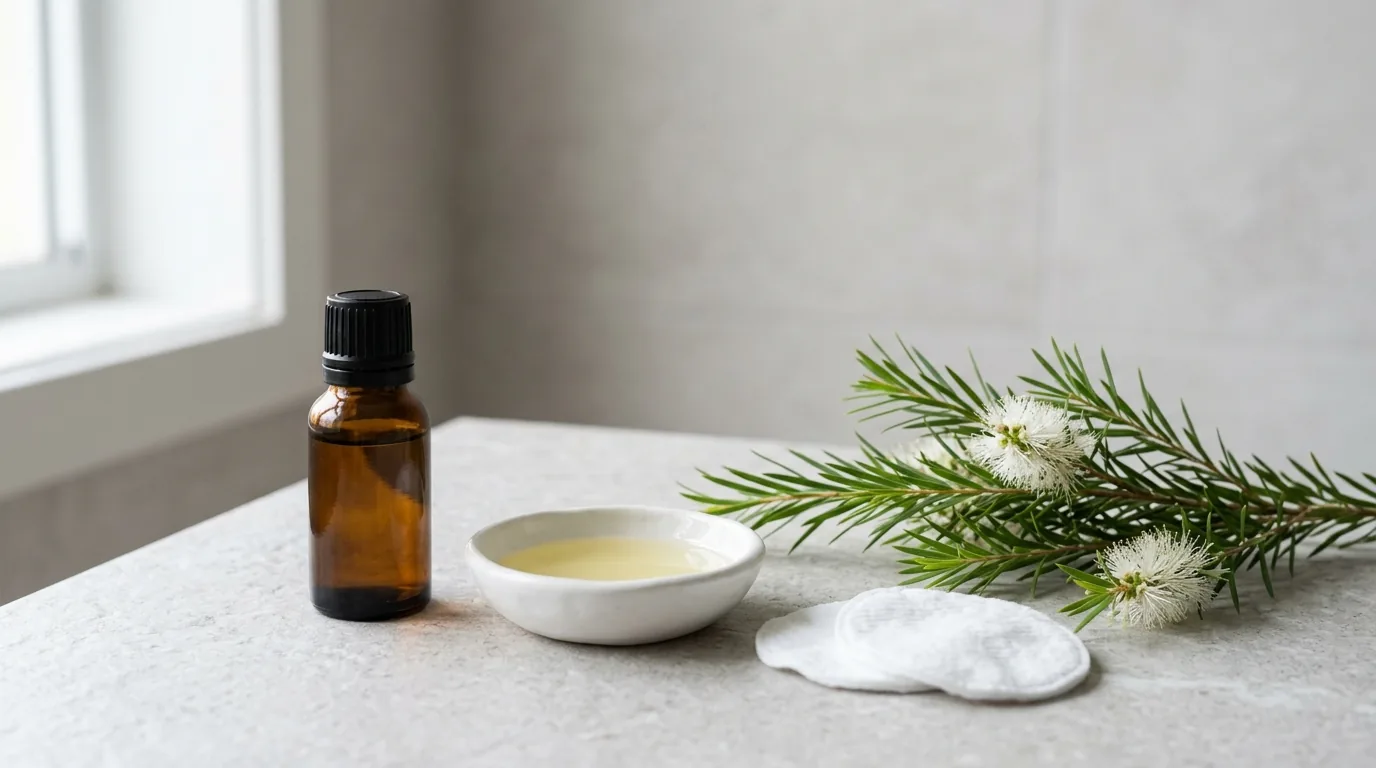
Tea tree oil is a plant oil sold for pimples, both as pure oil in small bottles and inside gels and washes. It has a small amount of real research behind it, all of it in mild to moderate acne, and it has a known safety problem: the pure oil sold in small bottles can cause an itchy skin allergy. This guide covers what the trials found, how tea tree oil compares with benzoyl peroxide, why the strength and age of the oil matter, and how to test it before it goes on your face. For natural acne remedies in general, including diet and home habits, see how to get rid of acne naturally.
What the trials found
Tea tree oil comes from the leaves of an Australian tree, Melaleuca alternifolia. Four pieces of research shape what can be said about it for acne.
| Study | Who took part | What it found |
|---|---|---|
| 1990 trial, Medical Journal of Australia | 124 people with mild to moderate acne | 5 percent tea tree oil gel and 5 percent benzoyl peroxide lotion both reduced inflamed and non-inflamed spots. Tea tree oil started working more slowly and caused fewer side effects |
| 2007 trial, Indian Journal of Dermatology | 60 people with mild to moderate acne | 5 percent tea tree oil gel reduced spot counts and severity more than a gel with no active ingredient over 45 days |
| 2015 Cochrane review | 35 studies of natural acne treatments, 3,227 people | The tea tree oil evidence came from a single trial and was rated low quality |
| 2026 review, Phytotherapy Research | 7 studies, 445 people | Tea tree oil was linked to a modest drop in acne severity. Side effects were mostly mild and on the skin |
In both trials, people were put into each group by chance, which makes a fair comparison more likely. Low quality in the Cochrane review means the trials were small or had flaws in how they were run or reported, so a larger trial could give a different answer. The 2026 review says the same thing in its own words: larger, better trials with standard products and longer follow-up are needed.
The US National Center for Complementary and Integrative Health (NCCIH), part of the National Institutes of Health, sums up the state of the research: "A small amount of research suggests that tea tree oil might be helpful for acne, but more evidence is needed before definite conclusions can be reached."
Two facts apply to every row of the table. Every trial used a gel with 5 percent tea tree oil, and every trial enrolled people with mild to moderate acne. Those two facts decide most of the practical advice below.
Tea tree oil compared with benzoyl peroxide
The 1990 trial is the only one in the table that put tea tree oil against a standard acne medicine. Both the 5 percent tea tree oil gel and the 5 percent benzoyl peroxide lotion reduced spots. The tea tree oil group took longer to see a change and had fewer side effects. The published summary names no winner on how much acne cleared.
Benzoyl peroxide has a different legal standing in the US. It is on the FDA's list of approved acne ingredients for products sold without a prescription, at 2.5 to 10 percent. That list also includes salicylic acid, sulfur and resorcinol. Tea tree oil is absent from it, so a tea tree product has no Drug Facts label with tested directions and warnings.
The American Academy of Dermatology (AAD) says benzoyl peroxide reduces acne-causing bacteria on the skin, and advises starting with a product that contains 2.5 percent, even though products go up to 10 percent. Skinli's plan follows that advice: it starts benzoyl peroxide 2.5 percent and adapalene 0.1 percent, every other night for two weeks, then every night. Benzoyl peroxide strengths explains why the lower strength is the usual starting point.
If you want to add tea tree oil to a routine that already has benzoyl peroxide or adapalene, add it last and on its own. FDA rules require acne product labels to warn that skin irritation and dryness are more likely if you use another acne medicine on the skin at the same time. Starting two new products in the same week also leaves you unable to tell which one caused a reaction.
Why pure tea tree oil can burn or cause a rash
Tea tree oil can harm skin in two separate ways.
Irritation. A strong substance damages the top layer of skin directly. A 2006 review of tea tree oil safety found it can irritate skin at higher strengths. The 2026 review lists burning, dryness, redness and scaling among the side effects seen in acne studies, mostly mild.
Allergic contact dermatitis. This is a skin allergy. The body's defence system learns to treat something as a threat, and after that, each new contact causes a rash where the substance touched the skin. DermNet, a dermatology reference site from New Zealand, lists tea tree oil among essential oils that commonly cause it. The rash is itchy, red and scaly. It usually appears 24 to 72 hours after contact and can spread beyond the area where the oil went. DermNet advises against putting undiluted essential oils straight on the skin, because this can start the allergy.
A skin clinic in Melbourne, Australia, checked its records for 4.5 years of allergy testing. Of 2,320 people tested, 41 reacted to tea tree oil. Of those 41, 27 remembered using tea tree oil before, and 8 had put 100 percent tea tree oil on their skin. These were people sent to the clinic for a rash, so the numbers show the allergy is real among people who already had a skin problem.
Old oil is the bigger risk
The same clinic found that oil from freshly opened products caused no or weak reactions in its testing. The allergy came from oxidised oil, meaning oil that air and light have changed. A 1999 study found tea tree oil kept in open and closed bottles broke down within a few days to several months. In animal tests, the broken down oil was three times stronger at causing an allergy than fresh oil. NCCIH gives the same warning in plain terms: skin reactions may be more likely if the product is old or has been exposed to heat, light or air.
In practice:
- Choose a finished product with a stated strength. The trials used 5 percent. A bottle of pure oil is 100 percent.
- Keep it closed, cool and out of light.
- Replace a bottle you have had open for months.
- Never swallow it. NCCIH warns that swallowing tea tree oil can cause confusion, unsteadiness, inability to walk and coma.
How to patch test a tea tree product
A patch test means trying a product on a small area of skin before it goes on your face. The AAD method is to put the product on a quarter-sized spot on the underside of your arm or the bend of your elbow, twice a day for seven to 10 days. How to patch test a new skincare product gives every step.
Three points matter more for tea tree oil than for most products:
- Test the exact product you plan to use, at the strength you plan to use. A test with a 5 percent gel tells you nothing about a bottle of pure oil.
- Do the full seven to 10 days. An allergic rash can take 24 to 72 hours to appear after contact, so a one-night test is too short.
- Stop at the first sign. The AAD says red, itchy or swollen skin means you should gently wash the product off as soon as possible and not use it again. A cool compress or petroleum jelly can calm the spot. If the reaction is severe and those do not help, see a dermatologist.
A product that passed the test can still cause a reaction months later if the oil has aged, so a new itchy rash near where you apply it is a reason to stop.
Does tea tree oil help whiteheads?
A whitehead forms, the AAD says, when extra oil and dead skin cells build up and plug the opening of a pore. The NHS describes whiteheads as small bumps, usually the same colour as your skin. Doctors call them closed comedones.
The 1990 trial is the only source in this guide that measured whiteheads. It found both tea tree oil gel and benzoyl peroxide reduced non-inflamed spots, which it names as open and closed comedones: blackheads and whiteheads. That is one trial, from 1990, with a 5 percent gel.
For whiteheads, the AAD's first choice is a retinoid, a vitamin A medicine that keeps pores from clogging. Adapalene is sold without a prescription. The AAD also says salicylic acid works best on whiteheads and blackheads, because it unclogs pores and removes dead skin. Give any treatment six to eight weeks before you judge it.
Leave whiteheads alone while you wait. The AAD says picking at whiteheads can lead to more whiteheads and acne scars. How to get rid of whiteheads covers the full routine.
Using tea tree oil on one pimple
People often dab tea tree oil on a single spot. Here is how that fits with what the sources say.
- A red spot at the surface. A patch-tested 5 percent product in a thin layer is the closest match to the trials. The trials treated whole areas of acne over weeks, so no source shows how fast it works on one spot.
- A deep, painful lump. The tea tree trials did not include cysts or nodules. The AAD says a dermatologist can inject a corticosteroid that flattens most acne nodules or cysts within 48 to 72 hours, and that only a doctor should do this. Blind pimple explains the home steps for a deep spot.
- A popped or open pimple. Tea tree oil can irritate skin, and no source in this guide tested it on broken skin. The AAD's wound care advice is to wash gently with mild soap and water and cover with petroleum jelly. What to do after popping a pimple has the full steps.
Whatever you put on a spot, keep your fingers off it. Should you pop a pimple? explains why squeezing pushes what is inside deeper and raises the risk of scars.
How long to try it, and when to see a doctor
The 2007 trial lasted 45 days, and the 1990 trial found tea tree oil worked more slowly than benzoyl peroxide. The AAD says acne treatment takes at least 6 to 8 weeks before you see fewer breakouts. Skinli's plan asks for 8 to 12 weeks before judging any treatment. Count your spots on the first day and every two weeks, in the same light, so you can see a change you might otherwise miss.
If the count has not dropped after 8 to 12 weeks, move to a treatment with stronger evidence, such as benzoyl peroxide 2.5 percent and adapalene 0.1 percent. Tea tree oil used on the skin may be safe during pregnancy and breastfeeding, NCCIH says, and a doctor or midwife should still confirm any acne product you start while pregnant.
The NHS advises seeing a GP if acne does not improve with treatment from a pharmacy, if spots are deep, painful or causing scars, or if acne is affecting how you feel. See a doctor as well for a rash that keeps spreading after you stop a product. Skinli gives education, and a doctor who can see your skin is the right person to diagnose it.
Frequently asked questions
How effective is tea tree oil for acne?
Tea tree oil has a modest effect on mild to moderate acne in small studies. A 2026 review of seven studies with 445 people found it was linked to a modest drop in acne severity, with side effects that were mostly mild and on the skin. The US National Center for Complementary and Integrative Health says a small amount of research suggests it might help acne, and more evidence is needed.
Is tea tree oil better than benzoyl peroxide for acne?
Tea tree oil worked more slowly than benzoyl peroxide in the one trial that compared them. That 1990 trial of 124 people with mild to moderate acne found a 5 percent tea tree oil gel and a 5 percent benzoyl peroxide lotion both reduced spots, and the tea tree oil group had fewer side effects. The FDA's list of approved acne ingredients includes benzoyl peroxide at 2.5 to 10 percent and leaves out tea tree oil.
Can you put tea tree oil directly on pimples?
Pure, undiluted tea tree oil on pimples raises the risk of a skin reaction. DermNet, a dermatology reference site from New Zealand, advises against putting undiluted essential oils straight on the skin, because this can start a skin allergy. A 2006 review of tea tree oil safety says it can irritate skin at higher strengths. The acne trials used a gel that contained 5 percent tea tree oil.
How to dilute tea tree oil for acne?
Tea tree oil in the acne trials was diluted to 5 percent inside a ready-made gel, in studies from 1990 and 2007. The closest match is a finished product that states 5 percent tea tree oil on its label. A 2006 safety review advises putting only diluted oil on the skin and using oil that has been stored correctly, away from heat, light and air. Patch test any tea tree product on your arm first.
Does tea tree oil help whiteheads?
Tea tree oil reduced whiteheads and blackheads in one trial. The 1990 study of 124 people found a 5 percent tea tree oil gel and 5 percent benzoyl peroxide both reduced inflamed spots and non-inflamed ones, including closed comedones, the medical name for whiteheads. For whiteheads, the American Academy of Dermatology recommends a retinoid such as adapalene, sold without a prescription, and says to give treatment six to eight weeks.
How long does tea tree oil take to work on acne?
Tea tree oil works slowly in the trials that tested it. The 2007 trial followed people for 45 days, and a 1990 trial found tea tree oil started working more slowly than benzoyl peroxide. The American Academy of Dermatology says acne treatment takes at least 6 to 8 weeks before you see fewer breakouts. Skinli's plan asks for 8 to 12 weeks before judging any treatment, tea tree oil included.
Can tea tree oil make acne worse?
Tea tree oil can cause a red, itchy rash that looks like acne getting worse. The US National Center for Complementary and Integrative Health says some people get redness or irritation. DermNet lists tea tree oil among the essential oils that commonly cause allergic contact dermatitis, an itchy, red, scaly rash where the oil touched the skin that usually appears 24 to 72 hours after contact. Stop using it if this happens.
Can tea tree cause allergic reaction?
Tea tree oil can cause an allergic skin reaction. A Melbourne skin clinic that patch tested 2,320 people over 4.5 years found 41 who reacted to oxidised tea tree oil, meaning oil changed by air and light. Of those 41, 8 had put 100 percent tea tree oil on their skin. The American Academy of Dermatology says to see a dermatologist for a severe reaction that cool compresses do not relieve.
Should tea tree oil burn?
A burning feeling is a side effect of tea tree oil, listed with dryness, redness and scaling in a 2026 review of seven acne studies. A 2006 safety review says tea tree oil can irritate skin at higher strengths. The American Academy of Dermatology says that if a product makes your skin red, itchy or swollen, gently wash it off as soon as possible and do not use it again.
Can I put tea tree oil on cystic acne?
Tea tree oil has no evidence for cystic acne. The trials Skinli read, from 1990 and 2007, included only people with mild to moderate acne. Cysts and nodules are deep, painful lumps, and the American Academy of Dermatology says a dermatologist can inject a corticosteroid that flattens most of them within 48 to 72 hours. The NHS advises seeing a GP when spots are deep, painful or causing scars.
Should I put tea tree oil on popped pimple?
Tea tree oil on a popped pimple puts an oil that can irritate skin onto broken skin, and none of the sources Skinli read tested it there. For an open spot, the American Academy of Dermatology's wound care advice is to wash gently with mild soap and water, then apply petroleum jelly so the wound does not dry out and scab. The AAD says anti-bacterial ointments are unnecessary if the wound is cleaned daily.
Is tea tree oil for acne safe during pregnancy?
Tea tree oil used on the skin may be safe during pregnancy and while breastfeeding, according to the US National Center for Complementary and Integrative Health. The same agency warns that tea tree oil should never be swallowed, because swallowing it can cause confusion, unsteadiness, inability to walk and coma. Ask your doctor or midwife before starting any acne product while pregnant, tea tree oil included.
Does tea tree oil expire?
Tea tree oil changes as it ages, because air and light react with it. A 1999 study found tea tree oil kept in open and closed bottles broke down within a few days to several months, forming compounds that start skin allergies more easily than fresh oil. The US National Center for Complementary and Integrative Health says skin reactions are more likely when a product is old or exposed to heat, light or air.
Sources
- Tea Tree Oil: Usefulness and Safety (National Center for Complementary and Integrative Health (NIH))
- How to treat different types of acne (American Academy of Dermatology)
- Acne: Diagnosis and treatment (American Academy of Dermatology)
- Adult acne treatment dermatologists recommend (American Academy of Dermatology)
- Acne: Signs and symptoms (American Academy of Dermatology)
- How to test skin care products (American Academy of Dermatology)
- Pimple popping: Why only a dermatologist should do it (American Academy of Dermatology)
- Minimize a scar: Proper wound care tips from dermatologists (American Academy of Dermatology)
- Acne (NHS)
- 21 CFR 333.310, Acne active ingredients (US Food and Drug Administration, Code of Federal Regulations)
- 21 CFR 333.350, Labeling of acne drug products (US Food and Drug Administration, Code of Federal Regulations)
- A comparative study of tea-tree oil versus benzoylperoxide in the treatment of acne (Medical Journal of Australia, PubMed record)
- The efficacy of 5% topical tea tree oil gel in mild to moderate acne vulgaris: a randomized, double-blind placebo-controlled study (Indian Journal of Dermatology, Venereology and Leprology, PubMed record)
- Complementary therapies for acne vulgaris (Cochrane Database of Systematic Reviews, PubMed record)
- Efficacy and Safety of Melaleuca alternifolia (Tea Tree) Oil for Acne: A Systematic Review and Meta-Analysis (Phytotherapy Research, PubMed record)
- A review of the toxicity of Melaleuca alternifolia (tea tree) oil (Food and Chemical Toxicology, PubMed record)
- Allergy to tea tree oil: retrospective review of 41 cases with positive patch tests over 4.5 years (Australasian Journal of Dermatology, PubMed record)
- Degradation products of monoterpenes are the sensitizing agents in tea tree oil (American Journal of Contact Dermatitis, PubMed record)
- Allergic contact dermatitis to essential oils (DermNet)
Copies a ready-to-post summary, then opens LinkedIn.
Get a routine built from your own photo.
One photo and two or three quick questions. Your acne score is free, with no account. The day by day routine is one payment, and nothing renews.
Analyze my skinSkinli gives simple tips for skin with pimples. It is not a doctor. It cannot tell you what is wrong the way a doctor can. If your pimples hurt, are deep under the skin, are getting worse, or will not go away, see a doctor.